

The South Shore Line: Still Moving Michigan City Forward
Long before daily commutes and weekend trips to Chicago became routine, the South Shore Line was already shaping the way Michigan City moved.
What many see today as a commuter rail service began more than a century ago as part of one of the Midwest’s most ambitious transportation systems: the electric interurban.
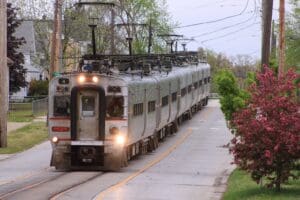
Electric interurbans were early 20th-century electric railways connecting cities and suburbs, utilizing high-voltage electricity (usually 600–1200V DC) delivered via overhead trolley wires or third rails.
In the early 1900s, long before the interstate system and before cars became a fixture in every driveway, interurban railways connected cities, small towns, and industrial corridors with a frequency that was revolutionary for the time. The earliest vision behind the line was not simply Chicago to South Bend. Original plans imagined a much larger regional network extending across Northern Indiana and beyond, with proposed connections reaching as far as Toledo.
To understand why that was a big deal, it helps to picture what travel looked like in 1905.
Roads were inconsistent, often unpaved, and heavily weather-dependent. Horse-drawn travel was still common. Steam railroads existed, but their schedules were built around long-distance travel and freight, not the daily movement of ordinary residents between neighboring communities. The interurban changed that.
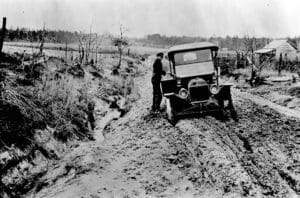
An early 1900s Ford Model T gets stuck in the mud after heavy rains on a dirt road in Ohio.
Suddenly, it became possible to leave Michigan City in the morning, travel to another city for work, shopping, or business, and return the same day. That kind of mobility was a major shift in daily life, especially in a growing industrial region along the southern shore of Lake Michigan.
The line officially began service in 1908 between South Bend and Hammond. At the time, this was cutting-edge infrastructure.
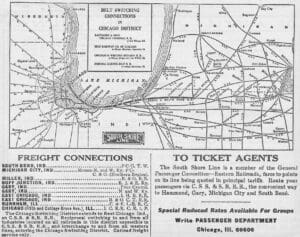
Early newspaper ad for the South Shore Line
The timing is almost perfect from a historical standpoint. The first Model T had only just entered production, and widespread automobile ownership was still years away. In many ways, the South Shore represented the future before the automobile did.
By the 1920s, it had become known for speed.
Historical records from the period show South Shore trains running at average speeds that matched or exceeded the automobiles of the day. For comparison, the Ford Model T, the most common automobile of the era, had a top speed of about 40 to 45 miles per hour. The South Shore was already operating above that on scheduled routes.
That speed proved to be not just a technical achievement, but a part of how the line sold itself.
The interurban era was intensely competitive, and rail companies across the Midwest marketed themselves on frequency, convenience, and speed. The South Shore was one of the strongest examples of that.
But what makes its history especially interesting is that it was never only about moving passengers.
Like many early rail systems, it quickly became tied to the economic life of the region. Freight, milk shipments, express deliveries, and baggage service all became part of its operations. In an era before overnight shipping, this significantly changed how commerce moved through the region.
A merchant could receive goods the same day. A resident could travel for shopping and be home by evening. Businesses could move products more quickly between cities.
That practicality is part of why the line lasted.
It also had elements that feel unexpected even by today’s standards.
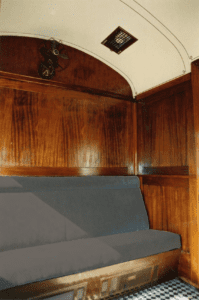
Insull-type smoking compartment in South Shore Line car #33. After smoking was prohibited on the South Shore Line in 1970s, these semi-private compartments became a passenger favorite. The usual office procedure in Chicago’s Loop was to send a person to the trains waiting for boarding at Randolph Street Station before quitting time so that they could “hold” a box smoker for the rest of the staff for the shared ride home. (Photographer credit: John P. Hankey).
During the late 1920s, the South Shore introduced parlor and dining car service. This was not a bare-bones trolley experience. Some cars featured wood interiors, rotating chairs, and onboard meal service, reflecting the broader passenger rail culture of the time.
For a railroad running through Northwest Indiana, it was a remarkably ambitious offering.
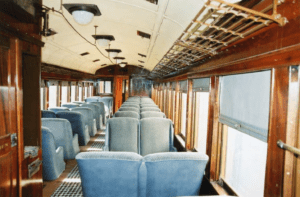
South Shore Line car #33 at Indianapolis, in 2004, over 4 million miles and 75 years after it entered service in February 1929. (Photographer credit: John P. Hankey).
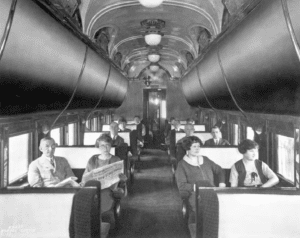
(Photographer credit: Asahel Curtis Photo Company).
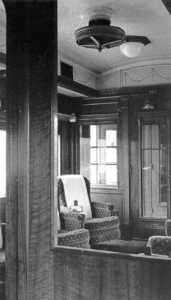
South Shore Line parlor car #352. Walnut paneling and rotating chairs spelled “Comfort.” (via: South Shore Line Museum Project)
Of course, the same decades that marked the line’s growth also brought the beginning of the end for most interurban railroads.
Once the automobile became affordable to working-class Americans, the entire transportation landscape changed. Roads improved, drive-in & rest stop culture grew, and one by one the interurban lines that had once stretched across Indiana disappeared.
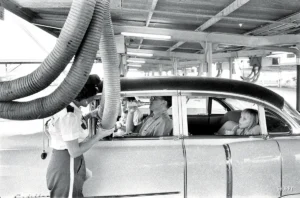
A family enjoys cool air piped into their car at a drive-in restaurant. 1957. (via: Shorpy Vintage Photography)
The South Shore was one of the few that remained, but not without struggle. The railroad faced ownership changes, financial instability, and serious threats of discontinuation. By the 1970s, there were legitimate discussions about ending passenger service entirely.
For Michigan City, losing the line would have meant more than the end of a rail service. By the time its future was being questioned, the South Shore had already been part of the city’s daily life for decades. Whether by design, timing, or a bit of both, it remained in place as regional travel patterns continued to change. As automobile use expanded, so did longer daily commutes, and with that came the familiar frustration of traffic delays and congested highways.
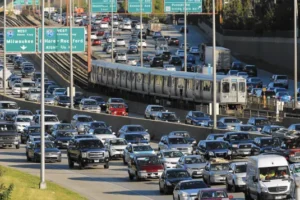
Chicago traffic with CTA train in background. (via: Chicago Tribune)
At the same time, the train continued to offer something the interstate could not: a more direct and often less stressful trip, where riders could read, talk, look out the window, or simply sit back instead of spending the drive focused on I-94.
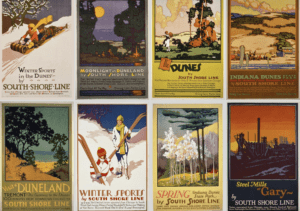
Classic South Shore Line advertising posters, now popular decor items for homes and offices throughout the region.
Today, Michigan City and the South Shore Line, along with several developers, are betting on that same longstanding belief: commuters want a peaceful start and end to the day, and tourists and locals alike want to experience the lakeshore and still be home that night.
Developments like The Franklin, an upscale apartment complex with a South Shore station built into the ground floor, are among the clearest examples of that vision taking shape.
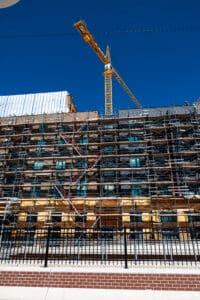
Construction on “The Franklin” progresses with windows overlooking the 11th Street South Shore Line tracks. (via: City of Michigan City, April 2026)
More than a century after its earliest version first took shape, the South Shore remains one of the clearest throughlines in Michigan City’s history, connecting the city’s industrial past, present-day commuters, and the next chapter of downtown development. In Michigan City, that history is not lost to an archive, it runs through the city every day.
This article was written using historical records courtesy of the South Shore Line Museum Project. For more information, articles & photos, visit: southshorelinemuseum.org