

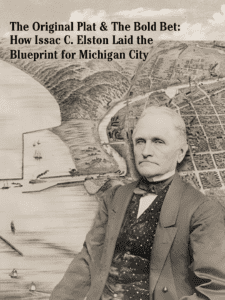
The Original Plat & the Bold Bet: How Isaac C. Elston Laid the Blueprint for Michigan City
In 1830, the southern shore of Lake Michigan was still frontier. Indiana had achieved statehood just fourteen years earlier, and northern LaPorte County remained lightly settled. Sand ridges bordered the lake, Trail Creek cut toward open water, and formal infrastructure was minimal.
That year, Major Isaac C. Elston, later appointed the first postmaster by President Andrew Jackson, made a bold and largely speculative decision. He purchased land at the mouth of Trail Creek for $1.25 per acre — sight unseen. The tract was soon divided into 206 lots, along with a designated public park and marketplace, all sold through the Michigan City Land Company. What began as a calculated gamble would become the structural foundation of an enduring lakefront city.
Within months of the purchase, Elston commissioned the platting of the Town of Michigan City. The original plat — later recorded at the La Porte County Courthouse on September 17, 1833 — laid out a grid of streets, divided residential and commercial parcels, and reserved public space. This formal survey transformed undeveloped acreage into an organized town site ready for settlement and commerce.
Early development moved quickly. In 1831, a post office was established, with Elston serving as Michigan City’s first postmaster, signaling federal recognition and providing essential communication links for settlers and businesses.
Transportation, Competition, and Early Ambition
The year 1832 proved pivotal. Michigan City was selected as the northern endpoint of the proposed Michigan Road, a major north–south highway intended to connect Lake Michigan with the Ohio River at Madison. A state selection committee described the location as “the most suitable site for a commercial town and the place the best harbor could be had.” That same year, the Indiana legislature ordered a formal survey of Trail Creek, recognizing its potential as a harbor.
Not all ambitions were realized. Also in 1832, Michigan City lost its bid to become the LaPorte County seat to the inland town of La Porte — a decision that shaped regional political geography but did little to slow Michigan City’s commercial aspirations.
Travelers already recognized the settlement’s promise. Statesman Daniel Webster passed through Michigan City in 1832, reflecting the growing visibility of the developing lakeshore community.
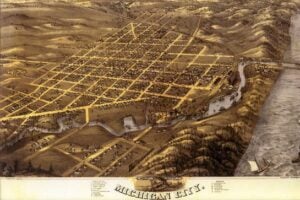
Photo shows the layout of Michigan City, IN a few decades later, in the year 1869.
The First Settlers and a Growing Community
Between 1832 and 1833, Joseph Furman constructed the first log cabin for Samuel Miller near present-day Fifth and Franklin Streets. Miller became Michigan City’s first permanent resident. By the fall of 1833, the town’s population had reached roughly fifty people.
Community institutions soon followed. Around 1833 or 1834, the first school building — known as the First Ward School — was erected at Fourth and Pine on land donated by Elston. Religious life developed alongside education, culminating in the construction of the Congregational Church in 1835.
Commerce expanded rapidly during the mid-1830s. Joseph C. Orr opened a tannery in 1834, while businesses such as blacksmith and tinsmith shops, taverns, hotels, a bank, and general stores emerged. Michigan City became both an outfitting point for westward settlers and a recreational stop for travelers moving along emerging routes.
Among the early arrivals was George Ames, who reached Michigan City in 1834, established a hardware business, and later became known for his philanthropy.
Building Toward a Harbor City
The town’s future depended heavily on water access. A harbor survey began on October 10, 1834, though insufficient funding prevented immediate completion. Continued interest led to an Army Corps of Engineers report on Trail Creek in 1835, reinforcing the site’s viability as a commercial port.
Transportation planning continued to validate Elston’s original vision. The Michigan Road, authorized by the Indiana General Assembly in 1832, would ultimately link southern Indiana directly to the lakefront, positioning Michigan City as a gateway between inland markets and Great Lakes trade.
Incorporation and Rapid Expansion
On February 8, 1836, Michigan City was officially incorporated under Indiana law and formally chartered on July 4 of the same year. The incorporated boundaries covered 15 square miles, making it one of the largest cities by area in the United States at the time.
By 1836, the population had surged to more than 1,500 residents, a remarkable increase from only a handful of settlers a few years earlier. Recognizing its economic importance, the State of Indiana granted $20,000 for harbor construction.
Symbolically and practically, Michigan City’s maritime future began that same year. On July 4, 1836, the first commercial vessel — the Sea Serpent — entered Trail Creek, marking the town’s emergence as an active shipping port.
Endurance Beyond Speculation
The broader context makes this period even more significant. The early 1830s were marked by land speculation across the Midwest. Towns were platted rapidly in anticipation of transportation routes and economic expansion. However, the Panic of 1837 halted development in many communities, and numerous speculative town sites declined or disappeared.
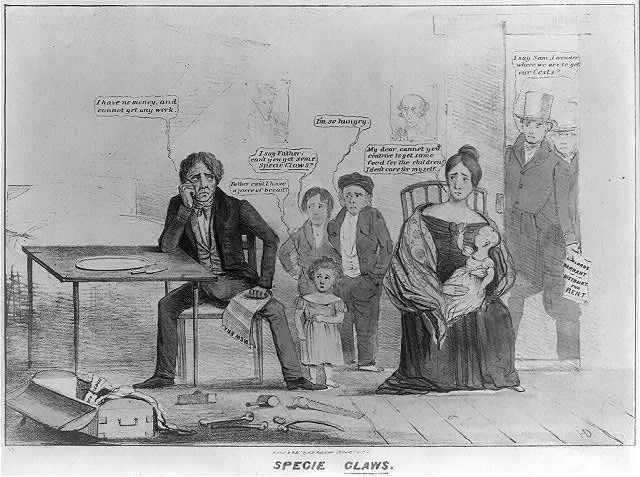
Edward Williams Clay, “Specie Claws,” 1837. Political cartoon criticizing Andrew Jackson’s Specie Circular and its perceived role in causing the Panic of 1837. Library of Congress Prints and Photographs Division.
Michigan City endured.
Its position on Lake Michigan, reinforced by the Michigan Road and harbor development, anchored it economically. Over the following decades, shipping, railroads, and industry strengthened the advantages Elston had recognized when he made his risky purchase in 1830.
As Michigan City marks 190 years since its incorporation in 1836, the anniversary highlights more than longevity. It points back to a moment when geography, transportation planning, and individual initiative converged.
The grid first recorded in the early 1830s still shapes the city’s downtown core. The mouth of Trail Creek remains central to its identity. The decision to purchase, plat, and promote land at that location established the structural framework upon which nearly two centuries of civic life have been built.
At its origin, Michigan City was more than planned — it was promised.
—
This article was written using various verified historical records and locally documented sources; including the Michigan City Public Library Archives which can be accessed at Michigan City Public Library