

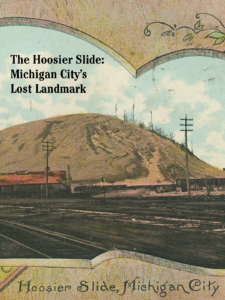
The Hoosier Slide: Michigan City’s Lost Landmark
Before industry reshaped the shoreline and long before protected dunes became part of a national park, Michigan City was known for something simple — a massive hill of sand that rose above Lake Michigan like a natural monument.
It was called the Hoosier Slide, and for decades it was the first thing visitors noticed when they arrived by boat. Sailors used it as a visual marker along the coast. Tourists climbed it for the view. Locals treated it as both playground and landmark. For a time, the towering dune was as closely tied to Michigan City’s identity as the harbor itself.
Today, nothing remains of it.
A Mountain Made by Wind and Water
During the 1800s, the southern shore of Lake Michigan looked very different than it does now. Wind carried glacial sand inland, slowly building dunes that shifted and reshaped themselves year after year.
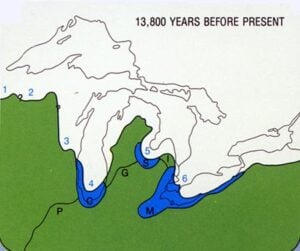
During the last Ice Age, a massive glacier up to two miles thick covered the region, carving the basin that would become Lake Michigan. As the ice retreated between 14,000 and 10,000 years ago, meltwater formed ancient Glacial Lake Chicago — the predecessor to today’s lake — leaving behind the shifting sands that would eventually create dunes like the Hoosier Slide.
The Hoosier Slide stood near the mouth of Trail Creek and rose roughly 200 feet above the lake — enormous by regional standards. Early photographs show a steep, almost bare slope, constantly moving under the force of wind.
Climbing it became something of a local tradition. Visitors made the effort of trudging upward through loose sand, only to run or slide back down toward the shoreline. Newspapers and travel writers regularly mentioned the dune when describing northern Indiana, helping put Michigan City on maps long before modern tourism campaigns existed.
For many early residents, the Hoosier Slide wasn’t scenery. It was simply part of everyday life — always visible, always changing.
When Visitors Came to Study the Dunes
By the late 19th century, the Lake Michigan dunes began attracting scientists as well as tourists. Researchers were fascinated by how plants slowly took root in shifting sand and how entire landscapes evolved over time.
But the Hoosier Slide was never only a subject of study — it was also a destination. Visitors climbed its steep slopes for sweeping views of Lake Michigan, while others gathered along its sides to rest, explore, and take in the scale of the towering dune rising above the shoreline. Excursion trains and steamships brought travelers from across the Midwest, many arriving simply to experience the climb for themselves.
The dune quickly became a place of spectacle and celebration. Merchants sponsored footraces to the summit, crowds gathered for seasonal events, and at least one couple famously exchanged wedding vows at the top, drawing residents and tourists alike up the sandy incline to witness the ceremony. In winter, daring visitors slid down its slopes on improvised sleds, while summer crowds treated the towering dune as both playground and landmark.
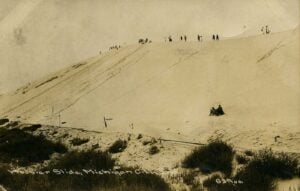
People enjoy Hoosier Slide at the top, while others sit along its side.
Botanist Henry Chandler Cowles of the University of Chicago conducted influential studies along the southern lakeshore in the 1890s, work that helped establish modern ecology as a scientific discipline. While much of his research focused east of Michigan City, the Hoosier Slide belonged to the same living dune system that made the region internationally important to scientists.
At the time, few people thought of dunes as fragile environments, especially compared to modern-day preservation efforts and education. In fact, they were mostly seen as abundant features waiting to be used.
The Sand Becomes Industry
What made the Hoosier Slide impressive also made it valuable.
Its sand contained high-quality silica, ideal for glass manufacturing. As Michigan City industrialized in the late 1800s, companies realized the dune itself could become a resource.
Mining began around 1890, at first modestly, then at an increasingly industrial scale. Railcars carried sand away for use in rapidly expanding glass factories across the Midwest. Companies such as Pittsburgh Plate Glass and the Ball Brothers Company in Muncie relied on Hoosier Slide sand, drawn by both its purity and its unique mineral composition. The iron-rich grains produced a distinctive light aqua color — the now recognizable “Ball Blue” seen in Ball-Mason jars that became fixtures in American kitchens. The same sand was also used by the Hemingray Glass Company to manufacture glass electrical insulators that lined telegraph and telephone routes during the nation’s communications boom.

“Ball Blue” Ball “Perfect Mason” Jar

Glass Telephone Wire Insulators

Blue glass insulators rest along a power line.
As excavation pushed deeper toward the lake-level layers of the dune, workers encountered more than shifting sand. Period accounts describe the discovery of human bones embedded within darker bands of red colored sand near the base of the Hoosier Slide, though the red color was thought to be a result of a high concentration of iron and other minerals. The finds were noted matter-of-factly at the time, during an era when industrial progress rarely paused for archaeological investigation, and no formal scientific study was ever conducted regarding the remains. Many historians today believe the remains may have originated from earlier Indigenous burial grounds elsewhere within the shifting dune system, exposed as centuries of wind-shaped sand were removed. However, their exact origin or tribal attribution remains unknown.
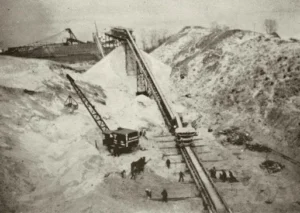
Excavation of Pigeon Hill in Muskegon, Michigan (1920s). A similar excavation process was utilized at the Hoosier Slide site.
Concern about the dune’s disappearance emerged surprisingly early. By 1894, observers noted that the once-massive landmark had already been reduced to roughly sixty feet in height. Still, demand for silica sand continued to grow. Mining operations expanded year after year until, by about 1920, the Hoosier Slide had been entirely leveled. Estimates suggest that as much as 13.5 million tons of sand were removed, though laborers from the site later said that number was closer to 9.5 million tons, citing the original estimation was based purely on average train cars leaving the site, multiplied by days of operation. Regardless, it was enough to erase the dune completely.
Even after its disappearance, the Hoosier Slide lived on indirectly. Ball Brothers had stockpiled large reserves of the sand, allowing production of their signature blue jars to continue until 1937. Only after those reserves were exhausted did the company transition primarily to clear glass, marking a quiet end to one of Michigan City’s most unexpected contributions to American industry.
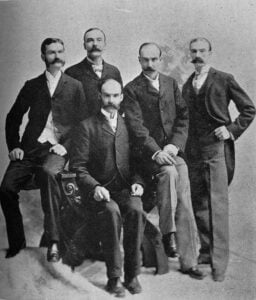
The Ball Brothers, known for Ball Corporation, Ball State University, and Ball Memorial Hospital. From left to right: William, Frank, Lucius (seated), Edmund, and George Ball
There was little public debate at first. Industry meant jobs, growth, and economic stability — priorities shared by many developing Great Lakes cities at the turn of the century. The disappearance of the dune happened slowly enough that it may not have felt dramatic day to day, even as photographs today reveal how quickly the landscape changed.
By around 1920, the Hoosier Slide was gone.
A Landmark Lost and a Lesson Learned
Only after its disappearance did many residents fully grasp what had been lost. The Hoosier Slide had not simply been scenery; it had been a defining feature of the shoreline.
Its removal became one of several examples conservationists later pointed to when arguing that the remaining dunes along Lake Michigan deserved protection. Those early preservation efforts eventually led to the establishment of Indiana Dunes State Park in 1925, followed decades later by the national park designation. It could be argued that the activism and civic pride for Michigan City’s lakefront seen today was inspired by environmental lessons like the Hoosier Slide excavation, with community leaders pledging to never allow private businesses or owners to dominate the lakefront again.
In an indirect way, the loss of the Hoosier Slide helped shape the conservation movement that saved other dunes from the same fate.
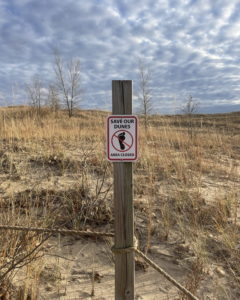
A modern “Save the Dunes” sign seen on a post, along with rope blocking foot-traffic, which causes dune erosion.
Remembering What Once Stood Here
Michigan City has reinvented its shoreline more than once — from frontier settlement to industrial port to modern lakefront community. The Hoosier Slide belonged to an earlier chapter, when a single natural landmark defined the horizon.
Today, the site is home to the Northern Indiana Public Service Company’s (NIPSCO’s) Michigan City Generating Station, and unless you’ve seen the photographs or read the accounts, it’s difficult to imagine a sand dune tall enough to guide ships standing where industry and infrastructure now sit.
But for nearly a century, the Hoosier Slide told travelers they had arrived at Michigan City.
And for those who lived here, it was simply part of home — until it wasn’t.
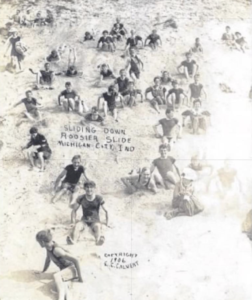
“Sliding Down Hoosier Slide” (Real Photo Postcards, 1906)
————————————————————–
Sources & Historical References

Primary Historical Sources
-
Blodgett, W.H. (June 14, 1919). “Indiana Dunes, Among the Finest in the World, Menaced by Commercialism, Seething Furnaces, Rumbling Machinery Threatens Nature's Work.” Indianapolis News.
-
“A Diminishing Hill.” South Bend Tribune, September 28, 1894.
-
Brennan, George A. (1923). The Wonders of the Dunes. Indianapolis: Bobbs-Merrill, p. 156.
Regional & Local Histories
-
Mueller, RoseAnna (2005). Michigan City. Arcadia Publishing, p. 69. ISBN 978-0-7385-3409-1.
-
Stodola, Barbara (2003). Michigan City Beach Communities: Sheridan, Long Beach, Duneland, Michiana Shores. Arcadia Publishing. ISBN 978-1-4396-3041-9.
-
Morrow, Jim (2001). Beverly Shores: A Suburban Dunes Resort. Arcadia Publishing, p. 120. ISBN 978-0-7385-0804-7.
Scholarly & Historical Context
-
Madison, James H. (1990). Heartland: Comparative Histories of the Midwestern States. Indiana University Press, p. 174. ISBN 978-0-253-20576-6.
-
Beiser, Vince (2019). The World in a Grain: The Story of Sand and How It Transformed Civilization. Penguin, p. 89. ISBN 978-0-399-57644-7.
Modern Historical Writing & Interpretive Sources
-
Ashcraft, Jenny (January 19, 2022). “Indiana's Most Famous Landmark Disappears.” Newspapers.com Official Blog. Retrieved January 24, 2022.
-
“What happened to Hoosier Slide?” Beachcombing Magazine, September 17, 2019.
-
Moser, JoAnn (2016). Mason Jar Nation: The Jars that Changed America and 50 Clever Ways to Use Them Today. Cool Springs Press. ISBN 978-1-59186-652-7.