

The Hidden History of Washington Park
Anyone who has spent time in Washington Park knows the feeling of it. The climb toward the observation tower, the sudden opening of lake views, and the winding paths that seem older than the city itself all give the park a sense of purpose. It feels settled, almost as if it simply grew into its present form over time.
In reality, much of what visitors experience today was built within a relatively short period during the 1930s. At the height of the Great Depression, federal New Deal programs brought large-scale public works projects to communities across the country. Among the most influential was the Works Progress Administration, which funded construction projects intended to provide employment while improving public infrastructure. In Michigan City, those efforts reshaped Washington Park in ways that still define the lakefront today.
Before the New Deal
Washington Park was established in the 1890s to provide public access to Lake Michigan for a growing industrial city. Early visitors found a pleasant but uneven landscape. Amenities clustered near the entrance, including a bandstand and small attractions that expanded gradually over time. Beyond those areas, much of the park consisted of open dunes and vegetation.
Even before the Depression, development moved slowly. Plans were discussed and improvements proposed, but large portions of the park remained unfinished. When the economic collapse of the early 1930s arrived, progress stopped almost entirely.
At the same time, parks became more important to daily life. Travel was limited and entertainment budgets disappeared. Public spaces offered one of the few accessible forms of recreation. Washington Park already attracted visitors, but much of its potential remained unrealized until federal relief programs arrived.
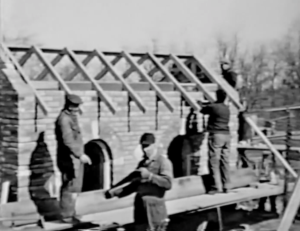
Workers add the roof to a Washington Park building/storage shed. (Michigan City Parks Dept. Archives)
Work Comes to Washington Park
Early improvements began under New Deal relief agencies that preceded the WPA, including the Civil Works Administration and the Federal Emergency Relief Administration. These programs focused on providing structured employment through practical local projects rather than direct financial aid.
The Washington Park Zoo became one of the first areas to see construction. Workers built animal shelters and the structure known as “Monkey Island,” often using reused materials gathered locally. Broken concrete, salvaged stone, and surplus building materials were incorporated throughout the park. Many benches and retaining walls still show evidence of that approach. Recycling was not a design philosophy at the time. It was simply the most efficient way to build with limited resources.
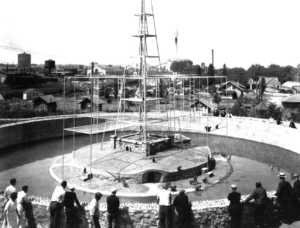
Spectators watch monkeys jump from point to point within “Monkey Island.” A water moat surrounds the island, designed to keep monkeys from escaping. (Michigan City Parks Dept. Archives)
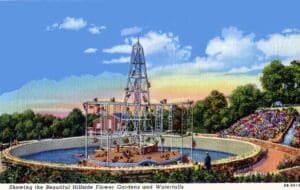
An idealistic illustration of Monkey Island portrays the exhibit against a colorful sky and lush flowerbed. (Michigan City Parks Dept. Archives)
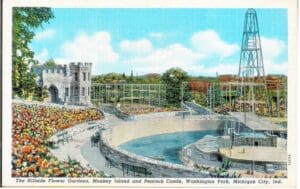
(Michigan City Parks Dept. Archives)
Several zoo structures built during this period still remain, including the primate house, feed barn, and the distinctive castle-like building that later became known as the Rotary Castle. These buildings were connected by a network of stone-lined trails, terraces, and viewing areas that shaped how visitors moved through the zoo.
A permanent administration building near the park entrance replaced earlier temporary facilities and reflected a growing commitment to long-term improvement. The work suggested that Washington Park was no longer being maintained as a seasonal attraction but was being developed as a lasting civic space.
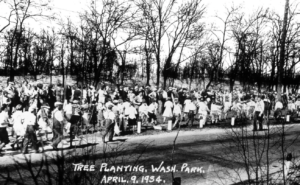
Volunteers planted 10,000 seedlings plus hundreds of larger trees to stabilize the dune and create the park. (Michigan City Parks Dept. Archives)
The Observation Tower
The observation tower, now one of the park’s most recognizable landmarks, emerged from this same period of activity. Construction began in the mid-1930s atop a dune rising nearly two hundred feet above Lake Michigan. A steel framework donated by the South Shore railroad provided the structure’s foundation, while federally funded labor completed the tower and reshaped the surrounding landscape.
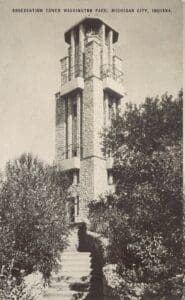
Washington Park Zoo Observation Tower Upon Completion (Michigan City Parks Dept. Archives)
When the tower was dedicated in 1937, visitors gained access to views that had previously required difficult climbs through shifting sand. Reaching the summit required more than erecting a structure. Workers built trails, retaining walls, and stabilization features that made the dune accessible while protecting it from erosion. Many of the paths followed today trace those original routes.
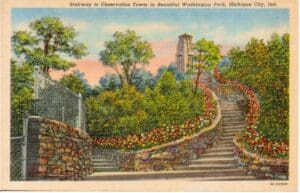
(Michigan City Parks Dept. Archives)
The tower itself reflects the architectural style popular during the era. Its limestone facing and Art Deco design gave the structure a distinctive character while allowing it to blend naturally with the surrounding stonework used throughout the park.
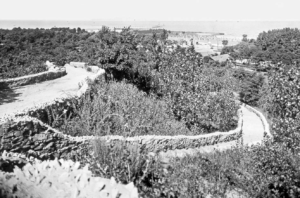
Early view from the site of the Washington Park Observation Tower, North facing towards Lake. (Michigan City Parks Dept. Archives)
Shaping the Landscape
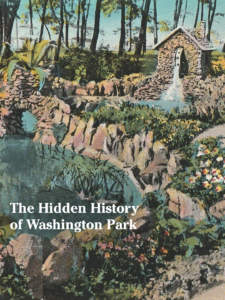
Throughout the late 1930s, work continued across Washington Park. Tennis courts were leveled into the dunes, picnic shelters were constructed, and extensive landscaping projects reshaped slopes and walkways. The rock garden introduced carefully arranged stonework, pools, and plantings designed to blend built elements into the natural environment.
Tree planting became one of the most significant contributions, though it was also the least immediately noticeable. WPA crews planted thousands of seedlings to stabilize the dunes and shape the park’s long-term landscape. Many of the mature trees that now shade the park began as part of those efforts.
Designers understood that the landscape they were creating would take years to fully develop. The goal was not quick improvement but lasting transformation.
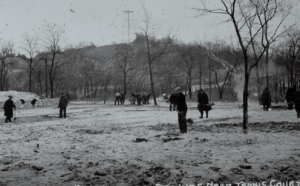
Improvement of tennis courts grounds, looking toward observation tower. (Michigan City Parks Dept. Archives)
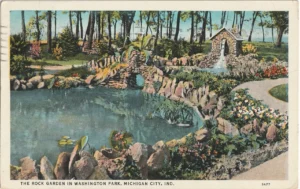
Illustration of The Rock Garden in Washington Park. (Michigan City Parks Dept. Archives)
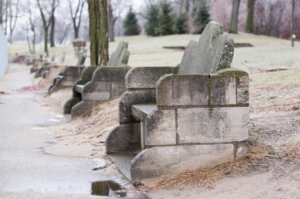
WPA era limestone benches photographed still standing in modern day Washington Park.
A Legacy That Blends Into Everyday Life
As wartime production increased in the early 1940s, unemployment declined and federal relief programs gradually ended. The WPA concluded in 1943, leaving behind projects intended to serve communities long after the crisis passed.
In Washington Park, those improvements became so integrated into daily use that their origins largely faded from public memory. The observation tower, zoo structures, pathways, and landscaped spaces came to feel like permanent parts of the park rather than the results of a single decade of construction.
What makes Washington Park notable is not simply that it contains WPA features, but that much of its identity was formed during that era. Many of the structures and landscapes that define the park today took shape when the country faced one of its most difficult economic periods.
Visitors climbing the tower, walking shaded paths, or pausing at a bench along the lakefront are moving through a landscape built with the belief that accessible public spaces mattered even during hardship. The investment was practical, but it was also optimistic. Nearly a century later, Washington Park continues to serve the same purpose, offering space, perspective, and connection to the shore of Lake Michigan.
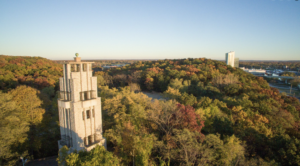
Modern-day photo of the Washington Park Observation Tower.
Videos:
The inclusion of video content created or published by independent sources does not constitute an endorsement by the City of Michigan City, Indiana.